






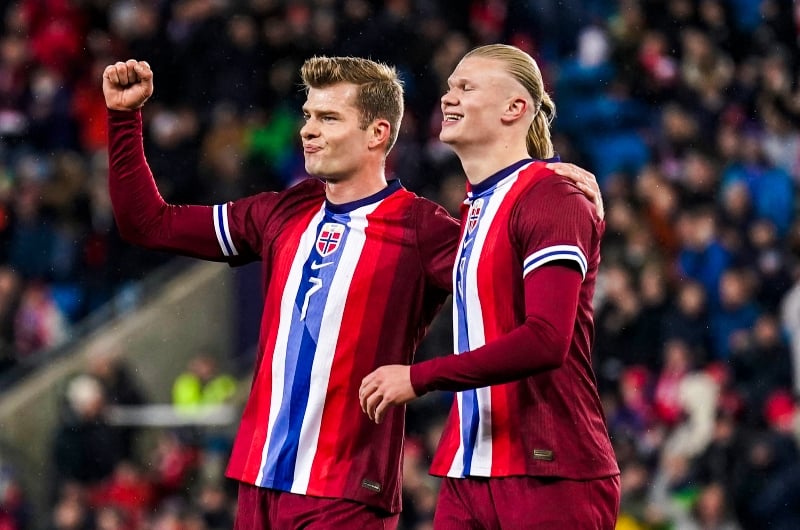
Norway’s campaign at the 2026 FIFA World Cup begins with a clash against minnows Iraq as they mark their highly anticipated return to the global stage after nearly three decades away.
All eyes will inevitably track the gravitational pull of Erling Haaland, who enters Group I as the most feared goalscorer after tearing through qualifying with a world-leading 16 goals.
However, for head coach Ståle Solbakken, the true structural puzzle has never been about Haaland's individual brilliance.
It is about the compromise of how to field two of the most physically imposing, prolific number nines in world football without upsetting the attacking balance.
In previous qualifying campaigns, deploying both Haaland and Atlético Madrid's towering marksman Alexander Sorloth meant a total positional gridlock.
Both elite forwards prefer to play down the middle, inadvertently running into each other’s operational areas and allowing compact defensive low blocks to mark them out of the match simultaneously.
But as the team prepares to face an ultra-conservative, deep-sitting Iraq side, Solbakken's tactical overhaul has permanently solved this equation.
The running lines have been separated to transform a historical bottleneck into a lethal, asymmetric pincer.
The Asymmetric Right Drift
The genius of Solbakken’s tactical resolution lies in the selflessness of Alexander Sorloth. Rather than deploying him as a conventional twin-striker locked in a rigid 4-4-2 box, Norway builds in a 4-3-3 baseline that intentionally transforms into a fluid front line.
On paper, Sørloth is deployed as a right-sided forward, but his role is defined by immense flexibility.
Standing at 1.95m, Sørloth does not hug the touchline like a standard winger but drops deeper into the right inside channels to absorb physical contact, acting as a link-man for Martin Odegaard.
By drifting into these wider corridors, Sorloth forces opposing left-backs and central defenders into a structural dilemma.
If they step out to contest his raw physical frame, the interior channels of the backline tear completely open. If they stay compact, Sørloth is handed the time to turn and act as a dangerous cross-and-assist threat.
The Haaland Vacuum
With Srloth successfully dragging the defensive weight of the opposition toward the right flank, Erling Haaland is liberated from the burden of constant double-marking.
Haaland’s role becomes one of pure vertical fixation, quick-passing progressive combinations on the right, the opponent's low block naturally slides horizontally to contract the ball side.
The split-second that shift occurs, Haaland drops onto the blind side of the isolated left-sided center-back.
Dissolving the Iraqi Blockade
This calculated separation is precisely engineered to dismantle the defensive system Graham Arnold has installed for Iraq's game with Norway.
Returning to the tournament after a 40-year absence, the Lions of Mesopotamia will happily sacrifice possession, drop into a compact low block, and look to squeeze the spaces in front of their penalty area.
If Iraq tries to run a traditional, centralized double-marking shield over Haaland, they leave themselves completely exposed to Srloth’s underlapping bursts or late-arriving vertical runs from Odegaard.
Solbakken’s hybrid system ensures that Norway can maintain relentless offensive pressure without ever compromising the clear, un-congested shooting lanes their superstar marksman requires to dominate the world stage.
A Harmonious Destruction of Space
This Group I opener will test whether geometric planning can overcome sheer defensive numbers.
If Norway approaches the match with a rigid, old-school mentality that clusters both of their physical giants down the center, they will play directly into the compact low-block structure engineered by Graham Arnold.
The true masterclass of Ståle Solbakken's system lies in its spatial discipline. By using Alexander Sørloth's massive physical profile as an inside-right axis to draw defensive cover away from the middle, Norway can systematically peel open Iraq's backline.
This ensures that Erling Haaland is granted the isolated, clear shooting corridors he needs to ruthlessly launch their World Cup campaign.