





European League Rankings Video Preview: How the Top Leagues Compare Right Now
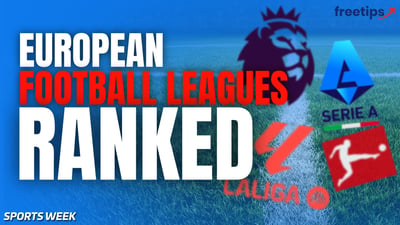
Debate around Europe’s strongest football league never truly goes away. In this Sports Week video preview, Dan and Tolu rank the top domestic leagues across the continent, examining depth, European performance and whether reputation still matches reality.
While the Premier League’s dominance feels unquestioned, the real discussion begins once the top spot is decided.
What’s at Stake in These Rankings?
League strength is no longer just a talking point. UEFA coefficients, Champions League qualification spots and global perception all depend on how leagues perform collectively in Europe.
A league’s ranking influences its financial pull, player attraction and competitive balance. Slippage over multiple seasons can have long-term consequences, particularly for leagues already reliant on one dominant club.
How the Top Leagues Stack Up
The Premier League sits comfortably at number one. Its depth, financial power and consistency in European competitions make it the benchmark.
La Liga follows closely. While often criticised for competitiveness, the presence of Real Madrid, Barcelona and Atlético Madrid, combined with Madrid’s continued Champions League dominance, keeps Spain firmly second.
Serie A edges the battle for third. Italian football has rediscovered depth, with multiple teams capable of competing domestically and in Europe. That collective strength currently outweighs Germany’s reliance on a single elite force.
The Bundesliga drops behind. Bayern Munich remain formidable, but the league’s overall depth has weakened, and genuine title challenges have faded in recent seasons.
France's Ligue 1 and the Eredivisie round out the conversation, offering strong top-end teams but lacking the consistency across the league to challenge higher-ranked competitions.
The Key Factor: Depth Over Dominance
This ranking exercise highlights a shift in how leagues are judged. A single powerhouse is no longer enough. European success increasingly rewards leagues with five or six clubs capable of competing at a high level.
Italy’s rise and Germany’s stagnation underline how quickly perceptions can change when depth disappears.
Expert Insight From Sports Week
In the Sports Week episode, Dan argues that Italy’s resurgence has been driven by collective competitiveness rather than individual dominance. He points to Germany’s over-reliance on Bayern Munich as a key weakness.
Tolu adds that while France and Portugal often produce elite teams, their leagues struggle to sustain momentum across European campaigns, limiting their ceiling.
The current hierarchy appears stable, but history shows these rankings are fluid. Investment, managerial cycles and European results can quickly reshape the order, particularly in the tightly contested middle tier.