






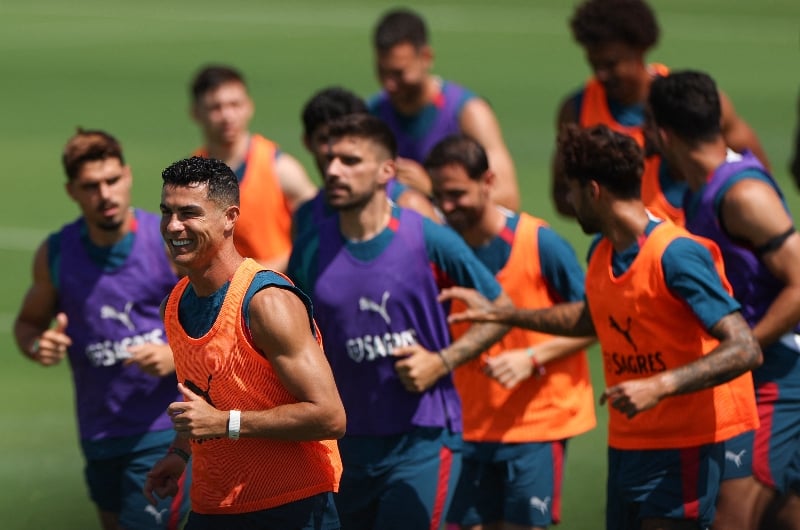
Cristiano Ronaldo launched his sixth FIFA World Cup campaign at the Houston Stadium, and the global spotlight was primed for another piece of history.
However, the disappointing 1-1 opening draw against DR Congo left a trail of tactical question marks across Roberto Martinez’s drawing board.
All the post-match conversations surrounded Ronaldo’s poor performance, with a specific focus on Portugal’s lack of attacking bite.
The captain's heatmap from the opening night reveals a highly stationary, condensed deployment model.
Rather than serving as an explosive spearhead to open up deep defensive lines, the 41-year-old icon operated as a static anchor.
He unintentionally compressed the central corridors, stifling the movements of Portugal's inside-forwards.
Lack Of Cohesion In Portugal's Forward Line
Modern attacking football relies on a fluid exchange of space between the center-forward and the wide wingers.
For explosive runners like Rafael Leão, Pedro Neto, or Francisco Conceição to break inside, the central striker must engage the opposition center-backs, pinning them deep to extend the passing channels.
Against DR Congo, Ronaldo's positional habits did the exact opposite.
His tracking map indicates that the majority of his work was heavily clustered in the right half-space and inside the penalty area, combined with occasional, deep dropping patterns toward the center circle.
By dropping deep to search for possession, Ronaldo recorded a mere 25 total touches, the fewest of any Portuguese player who featured for more than 45 minutes.
When the captain drops into those central pockets, he drags a marker with him, creating an immediate physical blockade.
If Leão or Conceição look to explode inward into the half-spaces, they run directly into a congested, crowded center, killing Portugal's transition speed and forcing the midfield to recycle possession sideways.
Cristiano Ronaldo Isolated With Long Balls
This lack of structural variety severely limited Portugal's ability to constantly make forays into dangerous areas. Because Ronaldo remained rooted in localized right-sided pockets, his threat was heavily restricted.
Without constant progressive runs to stretch the Congolese backline, Ronaldo's presence became entirely dependent on direct aerial supply lines.
Portugal defaulted to a highly predictable crossing model, floating balls into a heavily marked box that were easily collected by a defensively resolute opposition.
The Way Portugal Can Unlock Group K
As Portugal prepare for a must-win clash against Fabio Cannavaro’s Uzbekistan in their next clash, easing up the compressed frontline is Martinez’s most urgent priority.
Group K remains highly competitive, and another passive structural display could put qualification for the knockout stage of the World Cup in danger.
The solution is not necessarily a radical benching of the world's all-time record international goalscorer, but rather an enforcement of strict structural boundaries.
Martinez must instruct Ronaldo to abandon his deep dropping movements into the midfield spaces, maintaining a disciplined position close to the six-yard box to pin the Uzbek center-backs deep.
By keeping the central areas completely clear, Portugal can finally unlock the high-speed running lines of their wide players.
This will transform a static attacking shape into the explosive, fluid design required to break open a compact tournament defense.